A+ World Map Editor Sandbox
- 4.2
- Rating
- 500.00K
- Installs
- Free
- Price
 Analysis by App-foxy
I went into A+ World Map Editor Sandbox expecting a lightweight geography quiz, but its central idea is more unusual: it turns the world map into a playground for changing borders, imagining alternate histories, and building empires. That makes it more interesting than a simple “name the country” test, although it also means the experience depends heavily on whether you enjoy experimenting with maps rather than chasing a conventional score.
This is a free trivia game from App4Joy, rated for Everyone and available for devices running Android 8.0 or later. Its current version is 1.87-build-20260301.0933, and its store presence has already reached over 500 thousand installs. I also found a 4.1 average from around 4.7 thousand ratings, which feels consistent with my impression: the concept is appealing and distinctive, but it will not satisfy every player looking for a deep strategy game or a polished competitive quiz.
How the map editor changes the usual geography quiz
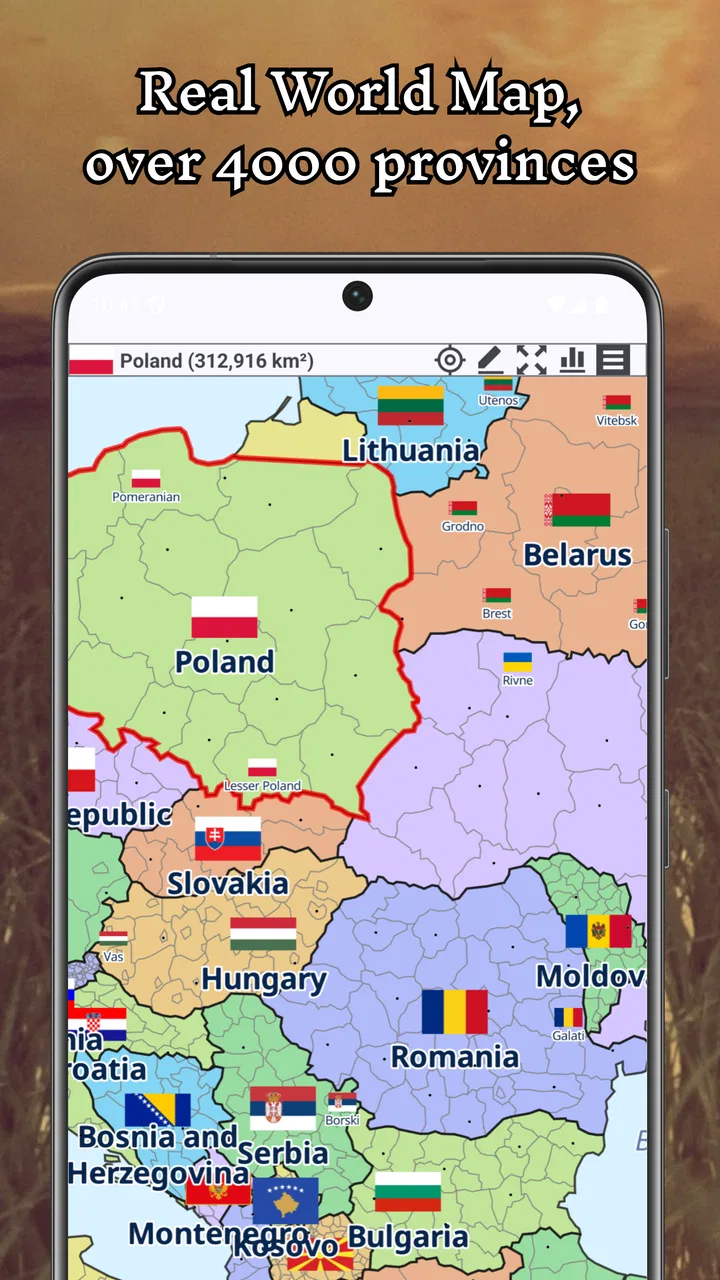
The first thing that separates this game from ordinary geography apps is the map itself. Instead of treating countries as isolated answers in a question list, it invites me to think about territory, borders, and political possibilities. The result is a more visual kind of trivia, where recognizing a region can matter just as much as remembering its name.
You May Also Like

 Blood Strike: 2.5 Anniversary
Blood Strike’s Loadouts Turn Every Drop Into a Tactical Gamble
A close look at Blood Strike’s custom loadouts: how fast access to signature weapons reshapes its battle royale rhythm, rewards preparation, and narrows the gap between fights.

 Pandora - Music & Podcasts
Pandora’s Music Is Easy to Start, but Harder to Recover
Pandora’s strength is its low-effort path from a seed to a station. Its weak spot is how much confidence it asks you to place in connection, setup, and quiet recovery.

 8 Ball Pool
 Is Built on Rivalries, Rematches, and Routine
A close look at the rivalries, rematches, shared routines, and unanswered safety questions that turn a quick pool match into a persistent mobile community.

 Samsung Music
’s Quiet Strength Is Playing What You Already Own
Its reach comes less from spectacle than from dependable access to a personal library. That simplicity is both the app’s strongest retention engine and its ceiling.

 AccuWeather: Weather Radar
AccuWeather Review: A Quick, Clear Forecast for Everyday Decisions
For everyday plans, the best forecast is the one you can understand quickly. AccuWeather makes rain timing, radar, and local conditions easy to act on, with a few trade-offs.

 Hill Climb Racing
Why Hill Climb Racing Still Turns Crashes Into One More Run
A tiny car, a bumpy hill and one more upgrade: Hill Climb Racing keeps resurfacing because its simple chaos makes every near-miss feel personal.
More From Our News Desk
View All News


That design gives the game two different personalities. In one moment, I can approach it as a geography exercise and test whether I know where countries belong. In another, I can treat the map as a sandbox for alternate-world ideas. Those two uses overlap, but they do not feel identical. Players who want a focused learning tool may prefer the first approach, while people who enjoy maps, historical “what if” scenarios, or creative world-building may get more out of the second.
The phrase “editor sandbox” is important here. I would not approach this as a traditional empire-management game with the same expectations I would bring to a full strategy title. The appeal is the act of redrawing and imagining, not necessarily the presence of a complex economy, diplomacy model, or long campaign. If you want detailed resource management and layered military decisions, a dedicated grand-strategy game is likely a better fit. If you want a quick way to manipulate a world map and turn geography knowledge into a creative activity, this concept is much more approachable.
I found the map-based format especially useful because it makes mistakes feel visible. In a normal multiple-choice quiz, I can guess, see the result, and move on. Here, the shape and position of a country remain part of the thought process. That visual connection can help reinforce regional knowledge, particularly for learners who struggle with lists of names but remember patterns and locations.
A practical way to use it for learning
I would use the game in short sessions rather than treating it like a textbook replacement. For example, after reading about a region, I could open the map and try to reconstruct its political layout from memory. The act of checking borders gives the session a purpose beyond simply collecting correct answers. It turns passive recognition into a small exercise in recall.
Another useful routine is to focus on one area at a time. Trying to absorb the entire world map in one sitting can become tiring, especially if the goal is accuracy. A better approach is to spend a few minutes with neighboring countries, then return later and see which shapes and positions stayed in memory. This is a personal workflow rather than a formal mode I would claim the game provides, but the editor format makes that kind of self-directed practice possible.
It can also work as a conversation game. I can imagine opening it with a friend and proposing a fictional border change, then discussing whether the resulting map makes geographic or historical sense. That social use is different from a standard quiz app, where the interaction usually ends with a score. Here, the map can become a prompt for discussion, storytelling, or friendly disagreement.
What progress feels like without turning it into pressure
The game’s strongest form of progress is knowledge-based rather than clearly tied to a conventional campaign. Every time I recognize a difficult border or stop confusing nearby countries, I feel that I have gained something useful. That kind of improvement is quieter than unlocking a new character or climbing a leaderboard, but it is also more durable when the player is genuinely interested in geography.
At the same time, players who need constant rewards may find the experience less motivating. The editor concept naturally encourages open-ended play, but open-ended play can feel vague if I am waiting for a clear sequence of objectives. I would recommend it more readily to someone who enjoys setting personal challenges than to someone who needs the game to tell them exactly what to do next.
A good self-imposed challenge is to redraw a region from memory before checking it against the familiar map. Another is to create a fictional political arrangement and then explain the geographic logic behind it. These exercises add structure without pretending that the game is a full course or a competitive ladder. They also reduce the temptation to make progress solely about finishing quickly.
There is a trade-off here. The freedom that makes the sandbox appealing can also make it harder to measure improvement. A conventional quiz gives me a clear percentage or score, while a map editor encourages exploration. Neither approach is automatically better. It depends on whether I want external feedback or prefer to define success myself.
Fairness and spending: what I would expect as a free player
The game is free to download, which makes trying the idea low-risk. I could install it, explore the map, and decide whether the editor suits me without committing money at the outset. That matters for a niche concept because the title’s appeal is difficult to judge from a short description alone.
When it comes to spending, I would be careful not to assume a purchase model that has not been clearly established. The information available identifies the game as free, but it does not give me a confirmed price list or a verified breakdown of optional purchases. I therefore would not promise that every feature is permanently available without payment, nor would I claim that the game is aggressively monetized. The sensible approach is to check the current store screen before downloading and review any purchase prompt in context.
That uncertainty is relevant to fairness. A map editor is most enjoyable when experimentation is not interrupted by pressure, but I cannot responsibly label the game pay-to-win or completely free of spending friction without confirmed purchase details. Since this is not a conventional multiplayer ladder in the information available to me, the usual competitive meaning of “pay to win” may not even be the right test. The more useful question is whether a free player can explore enough of the core map idea to decide if the game is worthwhile.
For families, the Everyone rating makes the game easier to consider as a general-audience title. Still, an age label does not replace normal supervision around device use or purchases. If a child is using it, I would show them how to handle any store or payment prompt and make sure the device’s purchase controls match the family’s preferences. That is practical caution, not a criticism of the game itself.
Competitive fairness is less important than creative fairness
Traditional trivia games are easy to judge competitively: everyone answers the same questions, timing matters, and the highest score wins. A sandbox map editor is harder to evaluate by those standards. Its value comes from what I choose to do with the map, so a player who wants a serious head-to-head contest may find the experience less satisfying than a dedicated quiz platform.
That does not make it unfair; it simply changes the type of fairness that matters. I care more about whether the game lets me explore its central idea without making the creative side feel pointless. If I redraw a border, build an imaginary empire, or test my knowledge of a region, the reward is the activity itself and the understanding I take away from it.
For direct competition, I would use it as a discussion tool rather than a strict tournament platform. Two players could compare their imagined maps, challenge each other on country locations, or debate whether a border follows a recognizable geographic pattern. That can be fun, but it is different from a standardized quiz where results are immediately comparable.
This is also why I would not judge the game by the standards of a large online strategy community. A serious strategy title may offer deeper systems and more formal competition, while a conventional trivia app may provide faster rounds and clearer scoring. This game occupies the middle ground: it uses trivia knowledge, but expresses it through map interaction and alternate-world creativity.
Small workflows that make the experience more useful
One of my favorite ways to approach a game like this is to separate creation from checking. First, I try to make a change or identify a region without immediately looking for confirmation. Then I pause and compare the result with what I actually know. That two-step process exposes weak spots in my geography memory much better than casually tapping through answers.
I would also avoid making every scenario enormous. A single border adjustment or regional idea is easier to reason about than an attempt to redesign the entire planet at once. Starting small keeps the map readable and makes it easier to explain why a change matters. Once the idea is clear, I can expand it if the game’s tools support the direction I want to explore.
A third approach is to use the editor as a prompt for research away from the game. If a border or region makes me curious, I can leave the app, read about the area, and return with better context. The game then becomes a visual starting point rather than a self-contained encyclopedia. That is a strength for curious players, although anyone seeking complete factual lessons inside one app may prefer a more structured educational product.
I would keep expectations realistic about precision. A map can make political geography look simple, while real borders often reflect complicated history, culture, agreements, and disputes. The game is well suited to testing recognition and imagining alternatives, but I would not treat every edited scenario as a serious explanation of international affairs. That distinction matters if the app is being used with younger learners.
Who should try it, and who should skip it
I think it is a good match for people who already enjoy maps, geography quizzes, alternate history, or casual strategy ideas. It is also a reasonable choice for a student who wants a more active way to revisit country locations, provided they understand that a sandbox is not the same as a complete curriculum.
It may appeal to parents looking for a general-audience game that can lead to conversations about regions and borders. The best family use would probably be collaborative: one person proposes a change, another identifies the area, and everyone discusses what the map now represents. That turns the app from solitary tapping into a shared activity.
I would skip it if my main goal were a deep political simulation, a highly structured lesson plan, or a tightly balanced online competition. A dedicated strategy game will usually offer more systems, and a specialized quiz app will usually make scoring and repetition more explicit. I would also hesitate if I dislike open-ended play, because the freedom to experiment can feel like a lack of direction.
Players with older devices should note the Android requirement of 8.0 or newer. That is not an unusual threshold, but it is worth checking before spending time looking for the download. The game is also listed for iOS, so people moving between mobile platforms have an alternative, though the exact experience can depend on the device and operating system in use.
What remains uncertain before downloading
The game’s public profile gives me a useful overview of its identity, audience, and basic availability, but I would still inspect the current store page before installing. In particular, I would look at the latest screenshots, read recent user comments, and check the purchase interface if one appears. That is the right way to resolve practical questions about current presentation and spending without guessing.
I would also decide in advance what I want from the session. If I open it expecting a complete empire simulator, I may judge it unfairly. If I open it expecting a visual geography sandbox with trivia value, the concept makes more sense. Defining that expectation is probably the single best way to avoid disappointment.
The rating gives some confidence that the idea works for a substantial group of players, but a rating alone cannot tell me whether those players wanted education, creativity, or simple entertainment. I would read comments with my own use case in mind. Someone praising the map editor may be describing exactly what I want, while someone criticizing the lack of a deeper campaign may be revealing a limitation that matters to me.
The release date of December 14, 2024, and the current build information show that the app has an identifiable development timeline, but I would still treat updates as something to evaluate on their own merits. A newer build does not automatically mean that every personal concern has been addressed. For a game built around a specific map-editing idea, the quality of the tools and the clarity of the interaction matter more to me than version numbers alone.
My trust verdict after weighing the trade-offs
My overall view is positive, with a clear condition: I recommend it for its unusual map-centered concept, not as a replacement for every other geography or strategy game. App4Joy has chosen a promising angle by combining trivia with border editing and imaginative empire-building. That gives the game a reason to exist beyond another list of questions.
The free entry point and Everyone rating make it approachable, while the broad install base and 4.1 average suggest that the concept has found an audience. I would still keep the spending question separate from those signals. Since confirmed purchase details are not part of the information I can rely on here, I would check the live store experience rather than making a sweeping claim about monetization or fairness.
My practical recommendation is to try it if you enjoy learning through visual experimentation. Begin with a small region, test what you remember, create one alternate border idea, and see whether the editor itself keeps you interested. If you quickly find yourself wanting diplomacy, economics, campaigns, or formal multiplayer scoring, move to a more specialized game instead.
For me, the most valuable part is the way it turns geography from something I merely recognize into something I can manipulate and question. That does not make every session equally compelling, and the open-ended structure may leave some players wanting stronger goals. But for a free trivia game with a map-editor identity, it offers a distinctive kind of play. I would recommend giving it a fair trial when curiosity about borders matters more to you than conventional scores or complex strategy systems.
FAQs for A+ World Map Editor Sandbox
01What features does A+ World Map Editor Sandbox offer?
A+ World Map Editor Sandbox provides users with a wide array of features, including customizable map creation, detailed terrain editing, and the ability to add various geographical and cultural elements. Users can also collaborate with others, export maps for different uses, and enjoy an intuitive interface that makes map creation accessible for beginners and experts alike.
02Is A+ World Map Editor Sandbox suitable for educational purposes?
Yes, A+ World Map Editor Sandbox is highly suitable for educational purposes. It allows students and educators to create detailed maps that can be used for teaching geography, history, and environmental science. The interactive features help in engaging students, making learning more dynamic and visually appealing.
03What are the system requirements for running A+ World Map Editor Sandbox?
To run A+ World Map Editor Sandbox smoothly, you need a device with at least iOS 11 or Android 5.0. It requires a minimum of 2GB RAM and sufficient storage space for storing maps and additional data. A stable internet connection is recommended for accessing online features and updates.
04Can I share my created maps with others in A+ World Map Editor Sandbox?
Yes, the app allows you to share your created maps easily. You can export maps in various formats and share them via email, social media, or other platforms. The app also supports collaboration, allowing multiple users to work on the same map project seamlessly, enhancing teamwork and creativity.
05Does A+ World Map Editor Sandbox include in-app purchases?
The app offers some in-app purchases that enhance the user experience. These purchases may include additional map elements, advanced editing tools, and premium templates. While the basic version of the app is fully functional, these optional purchases can expand your creative possibilities and provide a richer editing experience.
Pros
- Highly detailed map customization options.
- Intuitive user interface for easy navigation.
- Regular updates with new features.
- Supports collaborative projects with friends.
- Offline mode available for uninterrupted editing.
Cons
- Limited export formats for maps.
- Some advanced tools require in-app purchases.
- Occasional lag on older devices.
- No tutorial for beginners.
- Limited color palette in free version.

A+ World Map Editor Sandbox
Gallery